
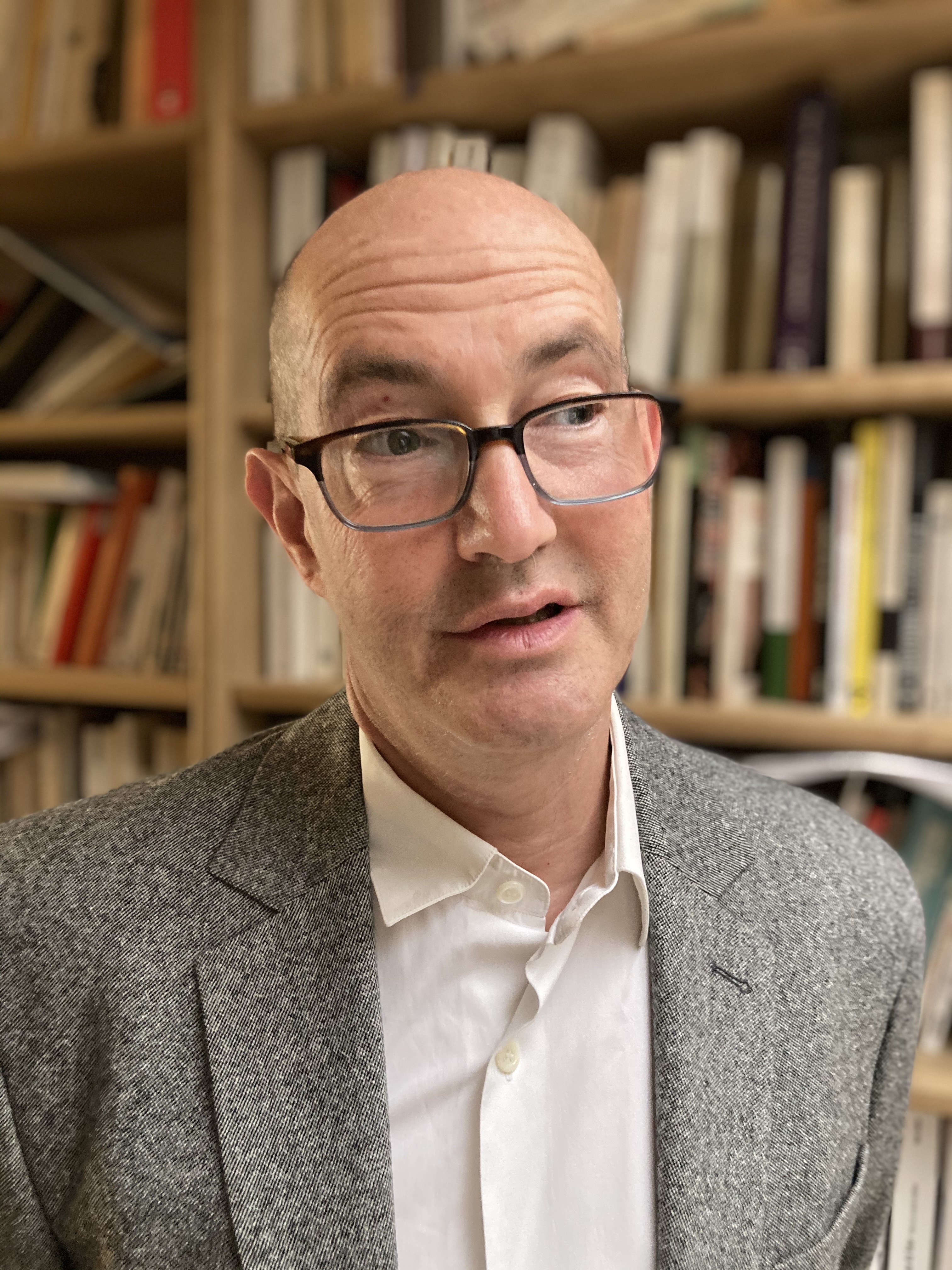
The commitment of Patrick Weil, President and Founder of Bibliothèques Sans Frontières.
A renowned historian and tireless advocate for access to knowledge, Patrick Weil founded Bibliothèques Sans Frontières 17 years ago with a simple but revolutionary idea: to make books and culture a lever for resilience and reconstruction in the most fragile areas of the world. Thanks to innovative solutions such as the Ideas Box, designed with Philippe Starck, the association is now active in more than 50 countries.
You are a historian. How did you come to create Bibliothèques Sans Frontières?
I specialize in legal issues related to immigration, nationality, and secularism. When I visited Africa, I noticed that although universities had buildings and teachers, they didn’t have any up-to-date books for students in their libraries. At the same time, families and young people in France didn’t know where to donate their books or school textbooks. Donations to Africa were often unsuitable for our partners or the libraries. So we created a donation chain that respects our partners around the world: they choose their books as we do in bookshops or libraries from a warehouse containing 1.5 million works, which we are constantly adding to.
Did your work take on a new dimension after the earthquake in Haiti?
Yes, it did. Immediately, librarians on the ground called us for help. And we realized that while there was money for the physical survival of the survivors—food, doctors, clothing, tents—there was nothing to restart schools or provide access to information, reading, or the internet. In a UN refugee camp, where the average stay is 20 years, people live without books, culture, connection to the outside world—everything that makes us human. So we designed the Ideas Box with Philippe Starck: a complete, portable cultural center that we deployed for the first time in a refugee camp in Burundi. Ten years later, it’s still in use.
What exactly is the Ideas Box?
It’s a cultural center that can be set up in 20 minutes and transported by cargo plane or van. It contains books, computers, e-readers, cameras, a power generator, a satellite connection if there is no Wi-Fi, as well as tables and chairs. All content is adapted to the local language and context. The Ideas Box can be set up in a forest, by a lake, at the foot of a building, or in refugee camps. It is a space for knowledge, but also for freedom.
Why do you continue to favor paper books in the digital age?
An African once told us: “Paper books are freedom.” You can’t monitor what page you’re on. The internet can be cut off in a second. You can’t burn all the books in a second. But we don’t pit one medium against another: we also use smart cards that give access to thousands of digital content, even without Wi-Fi. It’s complementary.
Is the content created locally?
Always. We don’t keep ownership of the boxes. We pass them on to trusted partners who we train for six months. Then they become the facilitators and owners. We provide support, but it’s the communities that bring these spaces to life.
What is the real impact of these initiatives?
It’s considerable. In the first camp in Burundi, during a revolt against the decline in food quality, the population protected the Ideas Box by forming a human chain. It was their most precious possession. In Colombia, after the peace agreements with the FARC, President Santos wanted an Ideas Box in around 20 villages to bring together children from factions that had been fighting each other. Evaluations show major effects on social cohesion, appeasement, and access to knowledge.
Are you saying that culture is a vehicle for peace?
Absolutely. In Syrian refugee camps in Jordan, the authorities observed that the lack of cultural spaces was causing tensions. When they rectified the situation by adding a cultural center, conflicts decreased. Culture is often perceived as a non-essential commodity. This is a mistake. It is what makes us human, beyond our animal survival. Speech, language, and exchange make us human beings. And that is what we must preserve.
In how many countries are you currently active?
We are present in around 50 countries, with content in around 30 languages. We also have local branches or sister associations in the United States, Italy, Spain, Belgium, and Switzerland. We are active in Ukraine, Poland, Lebanon, Turkey, Jordan, and Bangladesh. Gaza is not yet accessible, but we are ready.
Interview of Patrick Weil by Laurence Genevet